
Part 4: “Australian Experience with John Vlahides: Great Barrier Reef” [Video]

by vlahides on July 10, 2012

Apply here payday loans 100% secure


Snorkeling the Great Barrier Reef is like swimming inside a giant aquarium. But to get perspective on its vastness means also seeing it from the air – it’s the only living thing you can see from space.

Before co-producing and hosting these short films for Lonely Planet and BBC, I had never before ridden in a helicopter. What a brilliant place to experience for the first time the thrill of vertical liftoff! We flew 50 miles from the coast to a landing pad in the middle of the ocean (note my enormous grin as we step out of the helicopter), then shuttled to a floating dive station and snorkeled the reef. Lifeguards and roping kept snorkelers from drifting out to sea, and guides led us to clown fish hiding in anemones, past mountains of coral, with a rainbow of fishes surrounding me everywhere I looked. From the macro to the micro, seeing the reef from above and below changed my perspective on the ocean, and by extension, the entire planet.

Heart Reef, Great Barrier Reef, Australia – note the perfect heart-shaped coral reef, at center

{ 0 comments }


Before I visited Uluru for BBC and Lonely Planet, I thought, What’s the big deal about a rock in the middle of the desert? Then I stood beneath it, saturated in color and surrounded by shimmering silence, and I felt awe. Now I get it. This is a mystical place.
(formerly knowns as Ayer's Rock)
How incredible to imagine that Anangu people, the traditional owners of the land, have been around for 30,000 years, passing down oral tradition from parent to child for millennia. Consider this: when you come across an ancient rock painting at Uluru, the story told in the artwork is as fresh and alive to contemporary Anangu people as it was to their ancient forebears. Locals speak of tjukurpa, the catch-all term for regional law, stories, customs, relationships, and knowledge, which together create the foundation of Anangu society. Herein lies the key to wrapping your head around Uluru, something I only began to do. I wished I’d scheduled an extra day.

{ 0 comments }

Next week I’ll have the honor of performing Beethoven’s 9th Symphony, under the baton of Michael Tilson Thomas, at the San Francisco Symphony—and we’re recording it. (Last time we recorded, we won three Grammys.) If you appreciate classical music (well, actually it’s Romantic), I highly recommend you come. It’s nearly sold out, so buy tickets tout de suite. Meanwhile, if you’re curious to know what goes into creating a Grammy-winning recording, here’s a glimpse into the making of our last, Mahler 8. Erin Wall, soprano on that recording, will also be singing the Beethoven program.

{ 0 comments }

The second of five short films on Australia that I co-produced and hosted for Lonely Planet: Kangaroo Island. How surreal to see these wild animals up close—like a safari park, but without fences, people or cars. Incredible.

Kangaroos and wallabies are nocturnal. So many roam this island, and hop across the road at nighttime, that occasionally one gets hit by a car. But here’s the thing that distinguishes locals as good stewards of nature: custom dictates that the driver get out of the car to check the animal; if it’s a female with a baby ‘roo in the pouch—a joey, they’re called—it’s the drivers responsibility to take the joey home, raise it until it’s too big to live any longer as a pet, then turn it back to the wild.

I had the pleasure of holding one such joey in my arms. It kicked and squirmed and tried to get away, until I began humming “Brahm’s Lullaby” and rocking it like a baby. The ‘roo quieted right down, and even laid its head against my chest, a moment I’ll never forget.

{ 0 comments }

BBC America has been running a series of brilliant short films on Australia, which I co-produced and hosted on behalf of Lonely Planet. Wow, Australia—what a country.

No matter how many times I visit Sydney, I always get a thrill when I spot that spectacular harbor, and feel like I’m seeing it again for the first time. I can’t pick a favorite perspective—but how thrilling the view from the Olympic salt-water swimming pool beneath Sydney Harobur Bridge.

Hard to believe the Blue Mountains are so close to Australia’s biggest city. Dense eucalyptus forest, dotted with craggy rock formations, sprawl two million acres, exuding a mist of oil that refracts sunlight a smoky blue—hence the range’s name.

The birds are incredible. As we descended cliffs into a tiny pocket of rainforest, a pair of rare black cockatoos flew past at eye level. Tracing their route, I spotted other giant birds, the sort you only see in pet stores in America, perched wild in treetops, cawing and screeching an echoing chorus.

Dig the ride out of the canyon: you ascend via the world’s steepest railway. The film barely conveys the vertical drop, nor the sensation of feeling suspended, face first, inside a cage. My stomach was in my mouth. I can’t wait to do it again.

The view from the air of Sydney Harbour – note the swimming pool at the bridge's foot, and the opera house across the water.

{ 0 comments }

[Video]: Why It’s Fun to do Live TV

by vlahides on April 6, 2012

It’s always fun to do live TV. This week I appeared on ABC7‘s afternoon chat show, 7Live to inspire imagination about road-tripping California in springtime. For a moment I lost my train of thought, but discovered an on-the-spot solution to conversational stasis: Drum on the newscasters’ desk until you regain your rhythm. And laugh, always laugh. Honesty shines brightest.

Video: Why It’s Fun to Do Live TV from John Vlahides on Vimeo.

{ 0 comments }

[Video] Kitesurfing in Madagascar

by vlahides on April 11, 2011

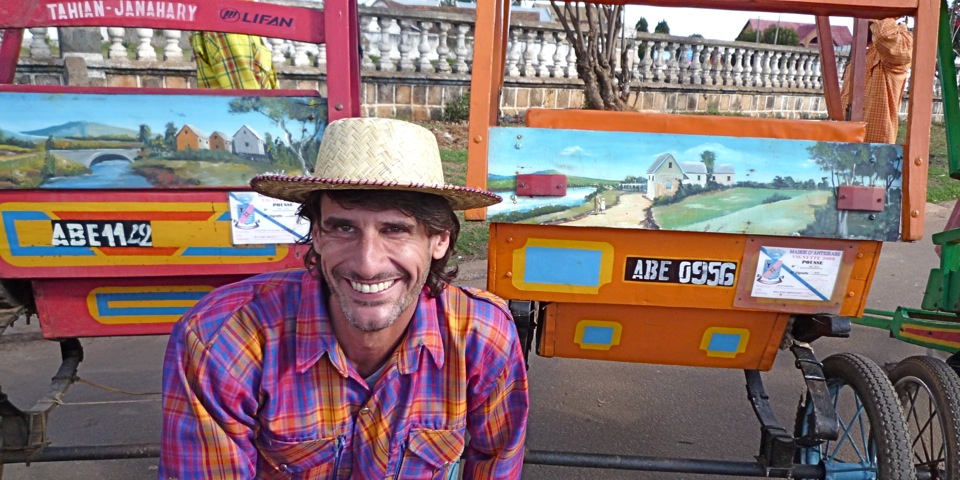
Adventure sports are as foreign in Madagascar as the concept of leisure time: in a country where 90% of the population has no running water, survival trumps entertainment. French entrepreneurs are trying to change that, investing in new tourism infrastructures to draw foreigners and (ideally) teach the locals new, marketable skills. In my investigation of this subject for NatGeo Television, I traveled to Sakalava Bay, where I had just two hours to learn to kitesurf—normally it takes three days. I’m already looking forward to returning to this barely known beach resort and showering the locals with greenbacks.

{ 2 comments }

How Great Britain Views the World

by vlahides on April 4, 2011

The following list surfaced in Harper’s magazine, January 2011, from a series of “Market Profiles” by VisitBritain, the official UK tourism bureau. Written “to help everyone in tourism, from taxi drivers to hotel personnel,” in preparation for the 2012 Olympics in London, the list was intended to “provide an even more efficient and helpful customer service that takes account of cultural needs.”

• Cleanliness is of major importance to Austrians.
• The Portuguese take great pride in wearing good fabrics and clothes of the best standard they can afford.
• New Zealanders are accustomed to high-pressure showers, not a weak dribble from a nozzle, and are also used to gallons and gallons of hot water being available.
• Although Italians give little care to public places, they are scrupulously clean in their own homes.
• Don’t be offended by Argentine humor, which may mildly attack your clothing or weight.
• Canadians often identify themselves as Canadian by wearing a maple-leaf pin or a maple leaf on their clothing.
• Czechs are very sensitive to price changes.
• Brazilians do not travel lightly.
• As a nation, Germans are interested in many things; however, football, cars, travel, culture, their homes, and getting a good deal are some of the most important.
• The Dutch have a strong desire to order their time in agendas and on calendars.
• Mexicans drink huge quantities of soft drinks and beer.
• Good conversational topics are Mexican culture, history, museums. Never discuss the Mexican American War, poverty, aliens, or earthquakes.
[click to continue…]

{ 0 comments }

Hilltop above Carmel Valley, California

Hwy 121 Westbound, Napa to Sonoma

Big rains this spring have greened the entire state of California, from north to south. What’s not green is white: the Sierra remain buried under the deepest snowpack in 20 years.  In a few weeks, once rainy season ends, everywhere but the mountains will turn gold—the color of lion’s fur, the dusty brown of tourist season. Now is the time for a road trip. As a professional travel correspondent, I always schedule California research trips for spring. Here’s why. [click to continue…]

{ 0 comments }

Burj al-Arab Casting Shade on the Persian Gulf

Dubai is home to some of the world’s most instantly recognizable hotels, but does the service measure up to the facilities? Some come close, but none I found merits the rarefied ranking of a real five-star. And that includes the iconic sail-shaped Burj al-Arab—which I prefer to call the Bourgeois à l’Arabe.

What distinguishes five-star from four-star service? The primary difference lies in the anticipation of a guest’s needs. A good hotel provides what you want before you know you want it. An example: You’re at a city hotel in, say, London, and step outside just as it begins to rain. Before you have to ask, the doorman offers an umbrella. Sure, any good four-star stocks umbrellas, but only the five-star will thrust one into your hand at the exact moment you need it, without your having to request it. Herein lies the problem. [click to continue…]

{ 4 comments }